
Saturday, 3 May 2014

Thursday, 24 April 2014
Scilly choughs
I did a quick trip to St Agnes on the Isles of Scilly last week with the missus. A bee-eater, which conveniently graced us with its presence while having lunch on the 16th of April was probably the highlight, but perhaps more intriguingly, I encountered a couple of chough.
I saw two associating with one
another on Castella Down near Long Point about 4pm on Mon 14th Apr.
One was the colour ringed bird in all of the photos below. I didn’t get a good view
of the legs of the other, but didn't notice a ring on it when in flight. I saw
both together so am sure there was two. The colour ringed bird remained on
Castella until Tuesday – although at times it was quite mobile – I also saw it
on Wingletang and I last saw it flying over to Annett.
I apologise for the quality of
the photos – the bird was quite distant and I was shooting into quite strong
light. I have attempted to crop a couple of the images and enhance them a bit,
which seems to show that combination is blue over red on the right leg and
black over a metal ring on the left leg.
I originally thought that the ringed bird I saw originated from Cornwall, but a bit of detective work suggests a different story. Genetic analyses suggests that, although the original choughs to arrive back in in the south-west originated from southern Ireland, it seems that a Breton is on the loose. Have a look at the bird in this photograph: http://www.cornishchoughs.org/tag/isles-of-scilly/. It is almost certainly the same bird as in the photo below. The bird was ringed as a nestling on the island of Oussant in 2007 and was resident there until at least 2011. It was then photographed at Baggy Point in North Devon back in February and was seen there again in mid-March. From there, it seems to have made it's way to North Cornwall, and evidently from there to the Isles of Scilly. This of course begs the question of where the other one came from? More excitingly perhaps,it does raise the prospect that Chough could appear on the Isles of Scilly as a breeding species!


Sunday, 2 February 2014
Footing it around the new patch
At the beginning January, I moved house to Porthleven – a small fishing village on the Cornish coast. A good excuse to test out the new patch and take part in Foot-it. The area does have a lot of potential. Loe Pool in particular can be pretty good for American ducks and has turned up quite a few rarities in the past (e.g. Black Duck, Lesser Scaup, Bufflehead) and being coastal, it always has the chance of the odd seabird. However, it lacks decent wader habitat. For this reason and because a holiday in the week of Jan, the act of moving house and a very busy job all competed with Foot it, I set myself a realistic target of 90. In the event I easily exceeded that target, but it was hard graft.

The local patch - getting Redshank and Greenshank involved a walk to Gweek
The first few days involved local sites. A Balearic Shearwater and Bonxie in the post-storm aftermath on my first day back from holiday started the challenge well. No Grey Phalarope, despite extensive searching. The photos below, actually taken last night after a lesser storm gives you some idea of the conditions.


Stormy weather - good for sea birds, bad for getting wet. Excuse the blurry photos. It was almost dark at the time. The house on the shoreline is large three story mansion and is perched almost 100m up the cliff. At the beginning of the year, the spray was breaking over the top of it.

Yellow-browed warbler. One of at least two overwintering the sheltered valleys. This one taken in better light a short while before my camera developed a fault (now fixed) in late December, but quite likely to be the same lingering bird.
Yellow-browed Warbler was probably the highlight of the second week – one of two that I eventually found over-wintering in the patch. A few unexpected birds in the third week: a pair of Pale-bellied Brent Geese on Loe Pool and Glaucous Gull nearby continued the good trend. However it wasn’t until the final week until I cleared up some of the easy birds: e.g. Goldeneye, Redwing, Fieldfare and involved trips much further afield than I thought would be necessary. I still missed some easy ones: Lapwing and Golden Plover – there just didn’t seem to be any about in the mild weather.

The full list. Target 90. Total seen 104.
A final assault at dark eventually my last species of the month: a Tawny Owl. Total miles: c. 120. Total species: exactly 104. Target exceeded by 115.56%!
Sunday, 17 November 2013
Lesser Whitethroat in my garden again
Edit: there is a good post by Martin Garner here and apparently things have changed a bit since I last looked into it. The race blythi ('Siberian' Lesser Whitethroat) - see paper here, has been reinstated and is the default "eastern" type. This is what I suspect the bird below is.
Popped down to Church Cove today and found this. Seemed to have all the features of halimodendri / minula / blythi type (Central Asian / Desert / Siberian Lesser Whitehroat). Behaving quite unlike a Lesser Whitehroat. Sticking to the upper and mid canopy in tall mature trees. Any thoughts on the race anybody?
Popped down to Church Cove today and found this. Seemed to have all the features of halimodendri / minula / blythi type (Central Asian / Desert / Siberian Lesser Whitehroat). Behaving quite unlike a Lesser Whitehroat. Sticking to the upper and mid canopy in tall mature trees. Any thoughts on the race anybody?
Apologies for crap photos - light was dire and then camera battery died. Didn't hear it call. Anyway - pretty sure it's not an Orphean Warbler


This was after the bird got wet, which probably accentuates the breast colour. Doesn't have much of a mask either and it's pretty clear the brown extends up the nape
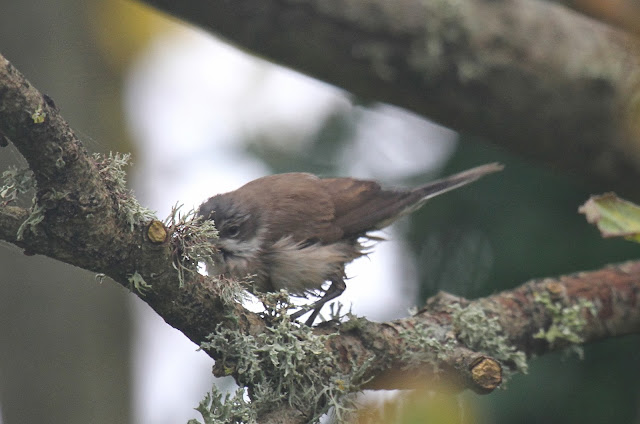 Another photo showing the brown extending up the nape. You can see the white on the tail on this photo too

The mask does look slightly darker in this underexposed photo, but you can see the peachy breast


Peachy flanks and breast contrasting with pale throat

This was after the bird got wet, which probably accentuates the breast colour. Doesn't have much of a mask either and it's pretty clear the brown extends up the nape


The mask does look slightly darker in this underexposed photo, but you can see the peachy breast

Another blurry photo showing the brown extending all the way up the nape. You can see the white on the tail on this photo too

A less blurry, but rather underexposed photo. The lores look pretty pale (or at least not as dark as I'd expect on a normal one.


Here's a few more taken by Tony Blunden


Here's a few more taken by Tony Blunden
Wednesday, 30 October 2013
Shetland versus Scillies: that old chestnut
Before I start, a quick update on the controversial Wheatear.
Steve has written an excellent account of for Birding
Frontiers. Could we have inadvertently been looking at something much rarer?
Probably best to put the whole thing
behind us, but I for one would be interested in what these beasties look like
as 1st winters.
Those of you who occasionally frequent Birdforum will be
familiar with the usual complaints about the demise of Scillies birding relative
to Shetland and will no doubt have picked up more than a whiff of
less than sweet grapes. People are of course entitled to their own opinions
and all I offer on here is a personal perspective. This year I chose not to
visit Shetland. Instead I spent a week on the Isles of Scilly, mainly on St
Agnes with Rob “I’ve already found a White’s Thrush” Curtis and Graeme “Cillit
Bang” Garner. Despite being present on “Aggie”
when the White’s Thrush turned up yet failing to see it and despite relatively
modest finds (RB Fly, a Sab Gull and a smattering of Yellow-browed Warblers), I
loved every minute of my time on the Islands. Stunning scenery, friendly people,
nice pubs and constant feeling that a rare bird could be just around the next
corner (although more likely in the bush I just passed). To me, the Scillies and Shetland offer a fundamentally
different birding experience and require a different mind-set and approach, yet
each have their merit.

Shetland: wind swept, cold, rainy, with scarce or rare
migrants clinging to any scrap of vegetation. A visit to the plantations on Unst have a
likelihood of turning something good up and even the smallest patch of nettles
can hold tired, weather-beaten migrants. Birding tends to be more predictable.
Easterlies spell numerous migrants and westerlies spell hard graft. Birding tends
to entail visiting hotspots (areas with some cover) and generally necessitates getting
around by car. The experience itself can often be quite grim: howling, cold
winds and rain, but the rewards can be exceptional.


Scilly: while I confess not to be much of a fan of the
peak-season twitching of every scarcity scene on St Mary’s, St Agnes has a special feel about it. £20 a night for a
nice room in a 3 bedroom self-catering cottage seems pretty cheap to me. I loved
being able to do the whole Island on foot. While the amount of cover and inaccessibility
of some parts of the island can make for a frustrating experience at times, this also gave me the feeling that many places
were less well covered than may parts of Shetland (notably Unst and South
Mainland), so the potential for finding something good is always high. More than that though, the birding experience
itself, even when there is little to be
found, is enjoyable. The scenery is stunning and even towards the end of
October the weather can be warm enough for shorts and t-shirt. It’s easy to pop
out for a couple of ours and then zip home for a cup of coffee. While the
rewards may not be as constant as on Shetland when the east winds blow it
certainly has much potential. It certainly punches above its weight. This piece
offers a nice perspective from the early 1970s and for anybody who visited in 1999, the close proximity of Siberian
and White’s Thrush must have been a memorable experience. I for one will be visiting again soon.
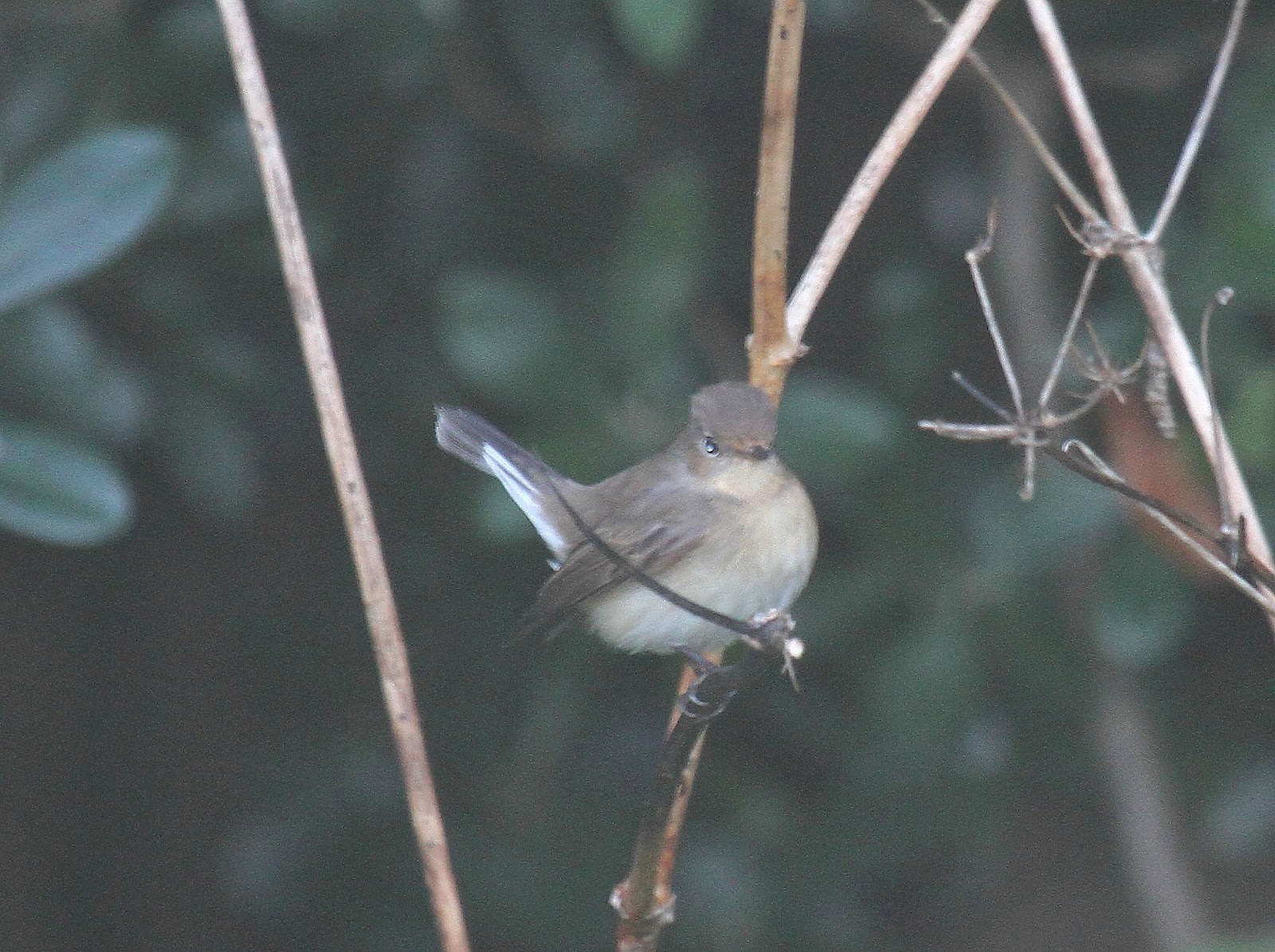




Red-breasted Flycatcher was probably my best find, but sometimes other things are nice to look at too.
 This bird, found by my birding companion Thor Veen on St Mary's when I last visited, is a reminder that the rewards on Scillies can also be high.

Saturday, 12 October 2013
Turtle Dove
Swarovski kindly agreed to fix my bins this week and sent me a loan pair free of charge, and I'd forgotten just how nice it is to go birding with proper optics. Despite the recent northerlies, there were quite a few migrants here and there, including a cracking Turtle Dove (only my second on the Lizard) and a Yellow-browed Warbler. The dove gave me a bit of a run-around, offering the very briefest of views when flying across the track down to Bass Point, but I bumped into it again in Lizard Village. Here's a couple of photos, along with one or two other more common things.


ps - expect more on the Wheatear in due course.


ps - expect more on the Wheatear in due course.
Thursday, 3 October 2013
Contraversial wheatears
Potential rarities on the Lizard never seem to be entirely
straightforward as those of you who remember the Green / Greenish debacle or
the Brown Shrike controversy will no doubt be aware. I suppose it should have
come as no surprise to me, therefore, that this wheatear would prove controversial.
Although many seem ready to dismiss it
out of hand, I think the whole case requires a bit more scrutiny. I for one, still
think it was a Black-eared Wheatear.
The find
I’ll start with a brief account of my involvement: about 4pm
yesterday, I got a call from Steve Votier, with whom I had been out birding
with early to say he was looking at Black-eared Wheatear. I understand he hadn’t
reached this decision immediately – only after 2 hours of watching it. When I
arrived and saw it, I must admit it didn’t fit my mental image of the previous
bird I saw on Scillies in 2010. The crown and mantle tone didn't seem right. It was much more subtle bird, but several
features made me pretty certain it was one, with the caveat that I haven’t got
a great deal of field experience of them. When I saw the photos however, I did
have doubts, and Steve and I spent most of today trying to relocate it to get
better photos, unfortunately to no avail.
Anyway, here’s a few more photos of it, some courtesy of Tony Blunden
and some I took, together with a few thoughts:
First off, the tail pattern: on the photos posted last night on
CWBPS , it doesn’t look right. However – in the field this was one
of the more obvious pro-features and I think I can explain what’s going on. If
you look at how many retrices are visible, you can see about 4 either side of
the dark central tail band. However there should be 5 visible on a
fully spread tail (see here). The tail isn’t fully spread, giving the terminal
tail band a flat appearance. Compare the right and left sides of tail on this bird, the same as in previous link for the effect this can have on the terminal tail band. In the field it was quite obvious that the
white was more extensive on T2 & 3 than on T1.


Second off, the axillaries. I saw these several times, and they were dark,
almost jet black. The photo below courtesy of Tony, isn’t the sharpest, but I’d
struggle how it could produce this appearance if they weren’t dark. I’d welcome
thoughts on how much of a clincher this is. I’m given to understand it is.

Third off, the size and structure of this bird was noticeably
different. Noticeably smaller and leaner, and somewhat longer tailed. You can
see that quite well on the photo below. It stood out like a sore thumb among
the 3-4 Northern Wheatears present for this reason.

Fourthly, and actually the most noticeable feature of the
bird was the extremely white belly and under tail coverts, which contrasted sharply with the more peachy toned
breast. It stood out like a Whinchat among Stonechats. I’ve never seen anything
like that on a Northern Wheatear, although I have to admit I don’t know how
important that feature is. None of the photos really do it justice, but the one
below gives you a bit of an idea, although in life the contrast was more
marked.

Fifthly, the extent of pale fringing on the tertials, but in
contrast to Northern’s I’m used to seeing, on the lesser and median coverts. It’s
really narrow giving the coverts and tertials a very dark and contrasting (with
mantle) appearance, which doesn’t fit with what I’d expect on a 1st
winter Northern Wheatear. Again, not sure how important this is, but it was
really striking (see photo).

Sixthly – the supercillium was most striking in front of the
eye, but one might expect that on a northern, this would be more striking
behind the eye. That said, it does seem quite pale and prominent for a
Black-eared.
The general tones to the upperparts were a bit pale and grey for my liking and extension of primaries relative to the tail long for my liking, but the former does seem to be quite a variable feature. The latter deserves a bit more scrutiny.
The general tones to the upperparts were a bit pale and grey for my liking and extension of primaries relative to the tail long for my liking, but the former does seem to be quite a variable feature. The latter deserves a bit more scrutiny.
Overall, I’m aware of the danger of trying to make it fit
Black-eared, rather than ruling out Northern, but this really was a striking
bird in the field and just didn't fit my mental image of any Northern I've seen.
That said, I’m not at all closed minded about this, and would
rather lose face than let it slip though if it wasn’t so welcome thoughts.
Steve will probably have something more intelligent to say about it in due
course.
Subscribe to:
Posts (Atom)